

By Apoena Mano
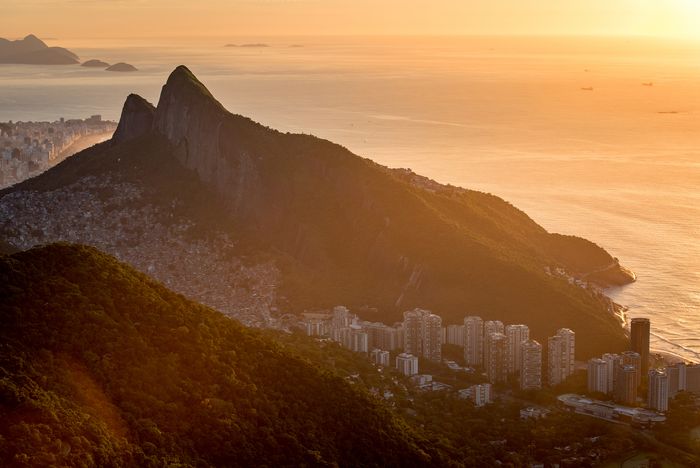
Rio de Janeiro, Brazil, is globally known as one of the most beautiful cities in the world. From the top of Morro Dois Irmãos, in Leblon, tourists often gather before sunrise to watch the city and the sea slowly emerge from the darkness. The composition of mountains, beaches, a lagoon and dense urban fabric forms one of Rio’s most recognizable landscapes.
But on 20 April 2026, this experience was suddenly affected. After hearing the unexpected sound of helicopters, tour guides immediately instructed the visitors to crouch down. At first, many of the visitors followed the instructions without fully understanding what was happening. Then another sound made the situation clearer: gunshots. A police operation was taking place in the surrounding favela, Vidigal. Around 200 tourists were temporarily trapped at the viewpoint, unable to descend safely.
What might have been understood as another episode in Rio’s long history of urban violence was framed in National and International media as a disruption of tourism mobilities: live broadcasts on TV showed how international visitors, highly valued for the revenue they generate, were stranded, frightened, and unable to escape from the situation (see also G1, 2026; Bosotti, 2026).
When shootings threaten tourism, it becomes immediately legible as a problem for the city - it affects visitors, tourism revenues, the destination’s international image, and the ability of tour guides and businesses to operate. However, when the same form of violence affects only residents, it is treated as part of the ordinary condition of life in the favelas.
The incident draws attention to a question about paradoxes of security, tourism, and racial dynamics in favelas of Rio de Janeiro: why the violence experienced as routine by many residents is considered exceptional when it affects tourist mobilities?
The making of “pacified favelas” as tourist attractions
Academic literature has shown how tourism can serve as a lens through which sociospatial inequalities become visible, particularly when we consider how different capacities to move safely through urban space are differentially and relationally enabled and constrained (Milano, Koens & Russo, 2024). Because tourism depends upon the promise of circulation, destinations are expected to provide environments in which visitors can move, consume, and experience the cities with a reasonable degree of predictability. Given the importance of securing the circulation of people, money, products, and images on which destinations depend, we must note how the safety of visitors is selectively prioritized and managed within tourist destinations in relation to that of residents (Becklake, 2023).
This discussion becomes particularly significant in light of Rio de Janeiro’s urban policies. The Pacifying Police Units (Unidades de Polícia Pacificadora, UPPs), introduced in 2008, emerged against the backdrop of geopolitical interests and preparations for major international events. These included, in particular, the 2014 FIFA World Cup and the 2016 Olympic Games. As one of the most paradigmatic public security programmes in the city’s recent history, the UPPs were linked to increasing efforts to present Rio as a secure and globally competitive destination. An important part of this government strategy was Rio Top Tour, a public-private initiative to promote tourism in the favelas. It aimed to support residents in developing their own businesses and position ‘pacified favelas’ as an attractive tourism product within Rio’s global tourism economy (Freire-Medeiros, 2013).
In its first years, the program was considered a success. However, after the 2016 Rio Olympics, the program's failure became undeniable. This moment marked the beginning of a period that revealed how increased favela tourism mobilities could coexist with the continued violence experienced by residents (Mano, 2018).
Whose safety is prioritized?
The incident in Morro Dois Irmãos was not isolated. Three months after, in July, a similar situation occurred. Dozens of tourists were trapped at a popular sunrise viewpoint in Morro Dona Marta as a gun battle broke out between police and drug traffickers, in the second such incident to affect visitors in 2026 (see also AFP, 2026).
What such violent situations mean for the local population had already been described in 2023 by Thiago Firmino, a tour guide and community leader in Santa Marta. Tourism, he explained, was only one of many areas of life affected. Local services were disrupted, children were affected on their way to school, and people had difficulties getting to work (O Globo, 2023).
Tourism provides an important lens through which to understand sociospatial inequalities in contemporary cities. For that, we might examine how tourists and residents experience urban spaces through differential capacities for mobility, shaped by their different positions within interconnected power relations. This perspective can be formulated through urban mobility regimes, an analytical framework for understanding how physical circulation is politically organized and unequally secured in contemporary cities (Mano, 2027).
This framework draws attention to the reproduction of colonial hierarchies that differentially enable physical mobilities, reflecting how racial dynamics shape whose movements are protected and facilitated, and whose are constrained, surveilled, or even rendered expendable. The cases of Vidigal and Dona Marta illustrate this dynamic: the same police shootings that attract attention when endangering predominantly white visitors in favelas are also those that disproportionately expose Black residents to lethal violence (Folha de S.Paulo, 2025).
Inequalities can be changed
But power relations include both the production and the contestation of inequalities. As I have recently argued in a co-authored article, a relevant profile of community leadership emerges as favela tour guides acquire the capacity to mediate and translate encounters between residents, visitors, government authorities, and other social groups (Freire-Medeiros; Mano, 2026). Their position can also enable them to intervene in broader debates over public matters by articulating perspectives that challenge dominant understandings of debates around security and tourism. In doing so, they foreground the racial dynamics constitutive of favela paradoxes. That is what happened after one of the most tragic situations involving tourism and urban violence in Rio de Janeiro.
In 2017, the Military Police of Rio fatally shot a Spanish tourist in Rocinha favela (see also Betim, 2017). Strong calls to suspend or condemn favela tourism in the city followed the incident. But favela tour guides pushed back and turned the debate around, posing a central question: “Whose safety is prioritized?” The accounts of Cosme Felippsen, a local tour guide from Providência favela, brought a racial dimension to the discussion that was largely absent from the dominant framing: while the death of a white foreign visitor could generate immediate concern about the dangers of entering the favela, the routine exposure to police violence of predominantly Black and poor residents was less visible:
“If it is wrong to go to visit the favela because it is dangerous, then it should be wrong to have people living there, right? At this very moment, while we are speaking, children are dying. And nobody cares. People want to go there to enjoy a samba, have a beer, but then something s*** happens, and they turn against the favela, pushing the favela away (...) They [the police] f*** things up and shift the responsibility onto the tour guides. (...) What exists is not a war; it is the extermination of a poor, Black, favela population” (Cosme Felippsen, cited in Betim, 2017).
Favela tours constitute an important element within Rio de Janeiro’s cultural and tourism sectors. Everybody should feel safe to watch the beautiful sunrises in the Brazilian city – and this is why, on the day after the shootings, a large group of people gathered during the morning at the same location in Morro Dois Irmãos (see also O Globo, 2026). However, the paradoxes of tourism, security and racial dynamics in favelas make us question why the protection of tourist mobilities so often becomes a privileged entry point for recognizing insecurity in places where residents have experienced multiple forms of violence for decades.
Apoena Mano is a postdoctoral researcher in the Department of Sociology at the University of São Paulo. He works in the FAPESP Collective Project “Evictions Observatory” (23/12851-7 & 25/24961-7) and is a member of the research groups “MTTM – Mobilities: theories, themes and methods (USP)” and “Cidades: Núcleo de Pesquisa Urbana (UERJ). He is the author of the book “Globalizing Favelas”, to be published by the University of California Press in 2027.
References:
Agence France-Presse (AFP). (2026, June 23). Shootout traps tourists at Rio sunrise lookout. RTL Today. https://today.rtl.lu/news/world/shootout-traps-tourists-at-rio-sunrise-lookout-2046373206 [22.09.2026].
Becklake, S. (2023). Touristic security: Not a ‘win-win’ global security practice. Conflict, Security & Development, 23(4), 289–316. https://doi.org/10.1080/14678802.2023.2268560
Betim, F. (2017, October 27). The dilemma of favela tourism: ‘If it’s wrong to visit, it must be wrong to live there, right?’ RioOnWatch. https://rioonwatch.org/?p=39758 [22.09.2026].
Bosotti, R. (2026, April 20). Police gunfight with favela gang traps 200 tourists on hilltop. BBC News. https://www.bbc.com/news/articles/cjr9vvr904wo?utm [22.09.2026].
Folha de S.Paulo. (2025, November 6). Risk of Black people being killed by police in Rio is 4.5 times higher than for White people, study says. Folha de S.Paulo. https://www1.folha.uol.com.br/internacional/en/brazil/2025/11/risk-of-black-people-being-killed-by-police-in-rio-is-45-times-higher-than-for-white-people-study-says.shtml?utm [22.09.2026].
Freire-Medeiros, B. (2013). Touring poverty. Routledge.
Freire-Medeiros, B., & Mano, A. (2026). Touristic governance in a Rio de Janeiro favela: Mobility regimes, network capital, and community leadership. Geopolitics, 1–28. https://doi.org/10.1080/14650045.2026.2695036
G1. (2026, April 20). Operação contra CV deixa turistas ilhados e ônibus fica atravessado no Rio de Janeiro. G1. https://g1.globo.com/rj/rio-de-janeiro/noticia/2026/04/20/operacao-policial-vidigal.ghtml?utm [22.09.2026].
Mano, A. (2021). Morro de medo: Regimes de mobilidades após uma década de Unidades de Polícia Pacificadora em favelas do Rio de Janeiro. Ponto Urbe, 27, 1–23. https://doi.org/10.4000/pontourbe.10148
Mano, A. (2027). Globalizing favelas. University of California Press.
Milano, C., Koens, K., & Russo, A. P. (2024). The politics of urban tourism (im)mobilities: Critical perspectives on inequalities and social justice. Cities, 152, 105148. https://doi.org/10.1016/j.cities.2024.105148
O Globo. (2023, May 27). Um dia após intenso tiroteio, PM segue no Santa Marta e clima é de tranquilidade com desconfiança. O Globo. https://oglobo.globo.com/rio/noticia/2023/05/um-dia-apos-intenso-tiroteio-pm-segue-no-santa-marta-e-clima-e-de-tranquilidade-com-desconfianca.ghtml?utm [22.09.2026].
O Globo. (2026, April 21). Um dia após visitantes ficarem ilhados, topo do Morro Dois Irmãos fica lotado no nascer do sol. O Globo. https://oglobo.globo.com/rio/noticia/2026/04/21/um-dia-apos-visitantes-ficarem-ilhados-topo-do-morro-dois-irmaos-fica-lotado-no-nascer-do-sol.ghtml?utm [22.09.2026].