By Christina Kamp, freelance author
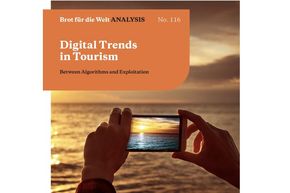
Digital technologies have proven disruptive for the tourism sector and have been changing the industry. Whether these changes contribute to improvements and promote sustainability largely depends on how and for what they are used. There are risks that they might also exacerbate existing problems or create new ones. In our new publication ‘Digital Trends in Tourism – Between Algorithms and Exploitation’ we look at some of the current tech trends in tourism and highlight associated risks and opportunities.
Our analysis shows the diversity of implications of social media, travel portals and apps, artificial intelligence (AI) and virtual reality (VR) in tourism. Travellers with their individual preferences now have new opportunities to develop their own personalised itineraries and to also make them sustainable. But can they trust AI? Using the example of ChatGPT, Sheikh Mastura Farzana points out the dangers involved in the use of generative AI models. Even though these models are getting better over time, they still reproduce stereotypes and generate a lot of false and misleading information that users need to verify.
Susanne Egermeier and Claudia Mitteneder (Institute for Tourism and Development – Studienkreis für Tourismus und Entwicklung) show that the use of digital travel guides and apps has made travellers more independent and more flexible. However, these tools also have blind spots, especially when it comes to travelling to the Global South. Where cultural codes are complex, infrastructure does not always function smoothly, and encounters with people are often more meaningful than sight-seeing, apps and AI systems easily reach their limits. The Studienkreis für Tourismus und Entwicklung article “Digital travel guides versus personal tour guides” is a plea in favour of local tour guides who do not just help guests to deepen their knowledge and broaden their perspectives, but also actively work to overcome prejudices and promote intercultural understanding and empathy – all things that digital guides cannot do.
Risks and opportunities of using social media
The intercultural and interpersonal dimensions of tourism are all the more important against the backdrop of how social media affect. Travel influencers tend to promote photogenic, ‘instagrammable’ destinations as backdrops to present themselves rather than as venues for intercultural encounters. This entails risks, as shown by Lea Thin in her article “How social media has been changing travel” – from distorted representations to overtourism in the places and regions promoted in this way. However, more and more influencers assume responsibility and promote sustainable travel. By deciding to present ecotourism, fair accommodation and local initiatives, they can motivate people to travel in more resource-efficient ways. Social media turn out to be both risks and resources – depending on how mindfully they are being used.
However, when it comes to protecting children, the risks outweigh the benefits, warns Antje Monshausen, managing director of ECPAT Germany, in her article “Digital initiation of contacts, local exploitation” on sexualised violence against children in tourism. The sexual exploitation of children and young people is one of the most serious human rights violations in tourism. The possibilities of digital cross-border communication have increased the risks significantly. Social media, online games with chat functions and dating platforms make it easier for travelling offenders – 85 percent of them are male – to initiate contacts. They enable them to exercise control and prolong the suffering of children in situations of exploitation. Both on social media and in the darknet, travelling sex offenders find spaces to network and to exchange information and images of sexualised violence. To protect children effectively, there is a need to strengthen prevention and intervention in the digital space through greater corporate responsibility in tech companies and tourism businesses, improved media literacy among parents and children, and more rigorous law enforcement.
Tech rather than people
While tourism has traditionally attracted visitors thanks to natural locational advantages such as beautiful sceneries, authentic culture and historical sites, there is a digital trend towards so-called ‘immersive’ experiences in artificial, curated worlds. Sights are no longer experienced with all the adversities involved, be it long queues, burning sun or sore feet, but through virtual reality and animations in disused factories or warehouses. My article on immersive formats shows that they are less authentic, but offer innovative approaches to presenting art, preserving cultural heritage or experiencing destinations that would otherwise not be accessible. They also open new opportunities for international cultural exchange and education on sustainable development.
Ernest Cañada from our Catalan partner organisation Alba Sud describes how technological change is affecting work in the tourism sector. He shows how, in the hospitality sector, digitalisation may reduce the workload for employees, but may also subject them to greater control, and might ultimately make them lose their jobs.Tasks such as check-in are delegated to the guests themselves (unpaid of course) who now get access to their accommodation by entering a code for a key box. In such a way, guests are unlikely to experience hospitality. Jobs that were already precarious in the first place are under threat of getting eliminated and the labour-intensive tourism sector will score less points with job creation.
Power and water consumption: Elephants in the virtual room
The articles show how in many areas of tourism human resources are being replaced by digital technologies. This has major consequences that extend far beyond the tourism sector itself. Many digital technologies require enormous computing power, causing significant CO2 emissions and driving climate change worldwide. Tourism applications add to the demand for resource intensive supercomputing centres that do both data storage and computation. Such centres also require huge amounts of water for cooling purposes, in addition to the water required by power plants, and the problems related to increasing amounts of electronic waste remain unresolved.
Not all of the new tech trends have reached the Global South to the same extent as they have become common in the North. Fortunately, in some respects: when employees are not so easily replaced by technology and interpersonal contacts and hospitality retain their value. However, the environmental consequences affect countries of the South disproportionately, whether they benefit from what is causing them or not.