By Christina Kamp, freelance author
For over 65 years, the German ASA programme has been working with partners in the North and South to promote international exchange through work and study projects. It has developed into one of the most successful programmes for young people in German development cooperation. Sustainability and tourism play an important role in many ASA projects.
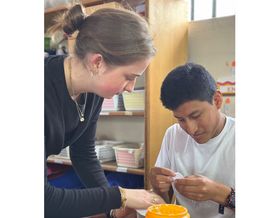
ASA (old German abbreviation for work and study projects) is a development-related programme for young people aged between 21 and 30 who during their studies or vocational training want to gain practical experience in an international context. Every year, the programme catalogue includes over 100 projects on various aspects of sustainable development. The projects last three or six months. The programme is funded by the German federal and state governments. To date, eight federal states have been providing financial and political support for ASA.
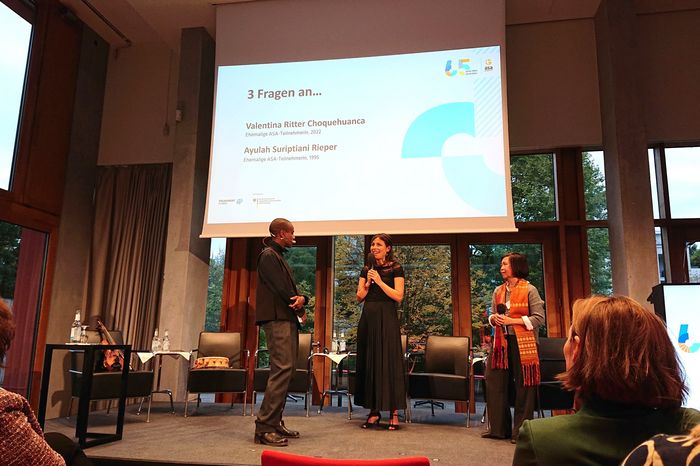
The ASA programme celebrated its 65th anniversary at a ceremony in Berlin on 9 October 2025. With currently around 280 participants per year, approximately 11,000 young people have taken part in the programme to date. One of them is Valentina Ritter-Choquehuanca, who enriched the anniversary celebration with her musical performance and made clear what ASA is all about. Her stay in Peru helped her understand how artistic work can also be political.
ASA tourism projects in 2025
Whether they focus on coffee cultivation, solar power systems or cooking technologies – the range of topics covered by ASA projects is as broad as the challenges of sustainable development. A glance at the catalogue for the current year 2025 shows that many projects have a tourism angle or explicit tourism focus.
For example, ASA participants are involved in the creation of a nature trail as part of a crocodile conservation project in a coastal village in western Ghana. The measures serve to combat poaching and environmental destruction. With the Red Rocks Initiative for Sustainable Development in Rwanda, ASA participants are developing ecotourism campaigns and carrying out environmental education activities to strengthen the local economy and raise awareness of nature conservation.
In Pekalongan, Indonesia, ASA participants are invited to assist with research on community-based mangrove ecotourism and to participate in the development of business models, infrastructure and marketing. In northern Laos, ASA participants work with BanSenSuk e.V. in Bremen, the Green Environment Conservation Team (GECT) and the Northern Agriculture and Forestry College (NAFC) to design an ecotourism concept for the agricultural college and develop information materials on environmental issues.
In south-western Paraguay, ASA participants support the Organización Paraguaya de Conservación y Desarrollo Sostenible (OPADES) in planning and conducting lectures and workshops on ecotourism, nature conservation and wildfire prevention. The Golden Youth Club in South Africa aims to make performing arts more accessible. Their project promotes intercultural exchange and uses the universal language of art to connect people worldwide.
With Voyages et Actions in Togo, ASA participants get the opportunity to produce reports and documentaries on everyday life in Kpalimé and Togolese cultural heritage. Finally, volunteering itself becomes the subject of an ASA project when a project with Voisins Solidaires Togo is aimed at further developing a volunteer programme based on an analysis of previous activities and at identifying new potential project partnerships where volunteering can make a positive contribution.
To ensure that the commitment of ASA participants benefits not just themselves but also their local project partners, the programme has undergone continuous improvement over the decades. Four features distinguish ASA from many other voluntourism programmes in the broadest sense:
No longer a one-way street
ASA was originally designed as a programme for students from Germany who wanted to gain project experience in Africa, Asia and Latin America. Vocational projects were added, and above all, ASA is no longer a “one-way street”. At the anniversary celebration, Ayulah Suriptiani Rieper provided testimony. She is a certified educator and was ASA’s first South-North participant in 1995. It was in the 1990s that the programme opened up to participants from partner countries in the South. Today, it prides itself on being a global programme, with projects mainly from South-Eastern Europe having been added. For Ayulah Suriptiani Rieper, “openness and joint learning” are particularly important; “This is how we can shape the future together”, she said. Participants from both North and South work together on sustainability projects – here and there. Accordingly, projects designed in the “global” format also include three-month project phases in Germany.
Scholarship instead of paid service
While many other programmes see voluntourism as a tourist service and market it accordingly, ASA provides scholarships to cover the participants' living expenses in the host country. These are awarded by ‘Engagement Global’ on behalf of the Federal Ministry for Economic Cooperation and Development (BMZ). Depending on the programme format, participants work for three or six months in Germany and in Africa, Asia, Latin America or South-Eastern Europe with local partners on tangible solutions for sustainable development. In the case of “ASApreneurs”, the cooperation partners are German companies in the partner country. Research projects are linked to universities.
Intensive preparation and follow-up
Unlike programmes that simply arrange project placements, ASA focuses on intensive preparation and follow-up. In preparatory seminars over several days, participants take an in-depth look at global issues – from post-colonialism to questions of social justice. They learn about the United Nations Sustainable Development Goals and the basics of development cooperation. In addition, there is country-specific preparation and a focus on intercultural communication. Participants also prepare for possible challenges in their respective projects.
After returning from their projects, participants get to share their experiences at a follow-up seminar. The preparatory and follow-up seminars are co-organised by former ASA participants.
Involvement and long-term commitment
Accordingly, participants from a new batch will also have future opportunities to join ASA as tutors or get involved in other ways. After participating in an ASA project, many of them remain active in the ASA alumni network and contribute to shaping the programme, for example by submitting their own project proposals. They share their knowledge as well as experience during their studies and careers – and are important communicators who often remain committed to social or developmental causes.
They strive for what Rudi Hoogvliet, representative of the state of Baden-Württemberg to the federal government, described as the programme's high ambition on the occasion of the ASA anniversary: To not just change the world, but to improve it. ASA needs more political support, says Hoogvliet. That is why he wants to work towards getting all federal states “on board” in the future. The challenge for the “next 65 years of ASA” consists in becoming even more global, even more diverse and even more courageous.