(Bonn, 07.02.2012) Chinesische Regierung verbietet Fluggesellschaften die Teilnahme am europäischen Emissionshandelsystem - EU Kommission will nicht nachgeben
By Anitha Sharma
The impacts of climate change in small islands like the Union Territory of Lakshadweep in the Arabian Sea manifests itself in myriad forms. The IPCC projects an increase in global mean surface temperature of 1-3.5 degree Celsius by 2100. Its best estimate of sea level rise is 50 cms over the next century, but it could be as high as one metre. Lakshadweep, which is part of India, is yet to acknowledge its vulnerability vis à vis sea level rise.
The 1997-1998 El Nino Southern Oscillation (ENSO) events elevated sea surface temperatures of tropical oceans as high as three degrees centigrade. This has been the most palpable effect in the Lakshadweep islands, with bleached coral comprising 82 percent of the total coral cover in the lagoon reefs, with a bleaching related mortality of 26 percent. The effect on marine biodiversity which is associated with loss of habitats gets reflected in the livelihood options and choices available for people. The reduction in availability of bait fishes, an essential prerequisite for tuna fishing, has had its impact on fisheries in Lakshadweep.
"We feel that the behaviour of the sea has changed. The tidal cycles have been disrupted. We are not able to predict ocean currents which used to bring in our fish. The wind pattern is not uniform. The seasons have lost their regularity." Many people remarked that the sea is alien to them, more so after the Tsunami. And: "The coastline of the islands has shrunk. More and more land has gone."
There is more evidence now that the most immediate consequences of climate change are likely to be extreme events such as flooding, tropical cyclones, storm surges, and heat waves, and climatic variability (droughts, prevailing winds accelerating coastal erosion). Sea temperature warming has ranged from 0-0.5 degree centigrade between 1971 and 2004 for the Indian Ocean region. "Rain has not decreased, but its regular frequency and intensity patterns have been disrupted", people observed. "The summers have become hotter. It is common for even average income households to budget a cooler/AC."
Apart from some brief mentions of the need to develop a climate change adaptation strategy and the promotion of renewable energy on the islands, Lakshadweep is yet to address issues concerning the global phenomenon. The new Administrator of this 32 sqkm Union Territory with a highly subsidised economy is a member of the Federation of Indian Chambers of Commerce and Industry (FICCI) Task Force on Climate Change. He is keen to address the issue in a proactive manner, as is evident from his Independence Day Speech (August 15, 2009), with practical tips to reduce carbon emissions and dependence on fossil fuels.
Tourism in Lakshadweep
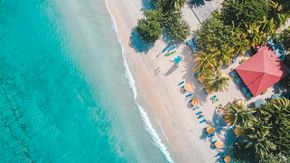
The tourism initiatives started in 1974, when the first resort for international tourists opened in Bangaram island. The Union Territory of Lakshadweep with its ten inhabited islands and several uninhabited islands has taken on the low volume - high value tourism. Tourism was expanded in 1983 to five islands, with restrictions in issuing permits to the tourists (4,000 per year).
The resort owners are yet to address issues of climate change, except for the usual rhetoric on eco-tourism designed on principles of how conservation pays. The Scuba Diving Training centre in Lakshadweep has been doing some outreach activities in the islands with children, symbolically taking up issues like garbage disposal. The Department of Environment and Forests in Lakshadweep has been observing days of importance like World Ozone Day with programs and distributing LED bulbs and lamps as a step towards a carbon neutral approach.
The need to assess the tourism carrying capacity of the islands has been stated clearly in a training manual ("Ecotourism in Coral Reefs". LEAD/BNHS/Darwin Initiative, March 2006), keeping in mind the imminent threat of global warming and sea level rise. The drive to increase the number of tourists to 10,000 and the decision to open up more uninhabited islands for tourism in Lakshadweep has to be placed in the context of underestimation that exists about this global phenomenon.
Anitha Sharma, an environmental educator and researcher based in Thiruvananthapuram, Kerala, India, has been working in the Union Territory of Lakshadweep for a decade.
(676 words, 57 lines, September 2009)